

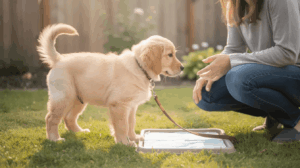
Successful potty training means your puppy consistently eliminates in an appropriate potty spot and can wait for a reasonable, age-appropriate period between breaks. Some puppies develop a clear signal when they need to go, while others continue to rely on a predictable schedule. Overnight bladder control also develops at different ages. An age-by-age approach works because puppy bladder control develops gradually, and matching your routine to your pup’s developmental stage reduces frustration from unrealistic expectations.
This guide covers puppy potty training from 8 weeks through 6+ months of age. It’s written for new pet parents bringing home a puppy for the first time, as well as owners struggling with indoor accidents despite their best efforts. Whether you’re house training in an apartment or on a large property, you’ll find actionable routines scaled to your puppy’s age.
Many puppies become reliably house trained by around 6 months of age, but the timeline varies considerably. Some puppies need additional time because of their individual development, previous living conditions, daily schedule, health, training consistency, or limited access to an appropriate potty area. Progress is better measured by a growing record of successful potty trips and fewer accidents than by a fixed deadline.
Here’s what you’ll gain from this guide:
- Age-specific schedule guidelines for each developmental stage
- Developmental milestones that explain why your puppy behaves the way it does
- Professional techniques including crate training integration, signal training, and indoor-to-outdoor transitions
- Troubleshooting frameworks for common setbacks like regression, frequent accidents, and communication breakdowns
Understanding Puppy Development and Potty Training Fundamentals
A one-size-fits-all potty training schedule can fail because a 9-week-old puppy and a 5-month-old puppy have different bladder capacities, cognitive abilities, and behavioral tendencies. Understanding how bladder control develops with age lets you set realistic expectations and build a consistent routine that works for your individual puppy. It can also prevent the cycle of frustration that leads some pet parents to give up or resort to punishment.
Puppy Bladder Development by Age
A commonly used planning guideline is that a puppy may be able to wait approximately one hour for each month of age, sometimes slightly longer under calm or sleeping conditions. However, this is an estimate rather than a guaranteed or recommended schedule. Activity, meals, water intake, excitement, health, and individual development can create a need to eliminate much sooner.
Here’s what to expect at each stage:
- 8 to 12 weeks: Bladder control is still developing. Offer breaks about every 30 minutes during active play and every 1 to 2 hours during quieter waking periods, as well as after meals, drinks, naps, and crate time. Many puppies still need one or more overnight trips.
- 3 to 4 months: Some puppies can begin waiting longer, but scheduled trips every 2 to 3 hours while awake, plus trips after common trigger events, may still be necessary. A consistent feeding schedule can make elimination patterns more predictable.
- 5 to 6 months: Many puppies can gradually handle longer intervals and may begin sleeping through the night. Continue providing daytime opportunities about every 4 to 6 hours or sooner after meals, naps, drinking, or vigorous activity.
These intervals should be adjusted to the individual puppy rather than treated as developmental guarantees. Veterinary housetraining guidance recommends especially frequent breaks during active play and regular opportunities while young puppies are awake.
This progression explains why expecting a 10-week-old puppy to wait three hours may lead to accidents. A 4-month-old puppy may be able to wait longer, but activity level, water intake, health, and previous training still matter. Age-appropriate expectations help prevent training setbacks before they start.
Natural Denning Instincts and Supervision Principles
Many puppies prefer to keep their sleeping area clean, which is one reason a correctly sized crate can support house training. However, this preference is not guaranteed. A puppy may soil the crate if it is confined longer than it can comfortably wait, has a digestive or urinary problem, or experiences significant distress.
When you can’t directly supervise your pup, use a correctly sized crate for an appropriate period or a secure, fully puppy-proofed pen or gated area. A laundry room should be used only if detergents, cords, appliances, and other hazards are inaccessible. Indoor tethering can help with supervision, but the leash must remain attached to an attentive adult and should never be used while the puppy is unattended.
Close supervision helps reduce indoor accidents during potty training. Observing for warning signs like sniffing, circling, restlessness, pausing an activity, or whining lets you catch possible pre-potty signals and guide your puppy to the appropriate spot before an accident happens.
The principle is straightforward: appropriate confinement reduces opportunities for accidents, supervision helps you catch signals, and frequent trips to the correct potty area build good habits. Understanding this developmental foundation is what makes the following age-specific routines effective.
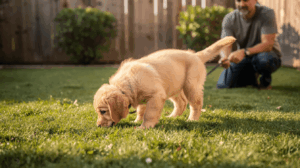
Age-Specific Potty Training Routines
Effective puppy potty training relies on a predictable schedule that evolves as your puppy matures and gains bladder control. Each phase below builds on the last, gradually increasing your puppy’s independence while maintaining the structure that helps reduce accidents.
8 to 12 Weeks: Foundation Building Phase
This phase demands the most active management from you because your puppy’s bladder control and awareness are still developing. Your job is to provide frequent opportunities for successful elimination in the correct location so that appropriate potty habits become established before indoor patterns develop.
Schedule: Take your puppy outside immediately after waking and eating. Also take them out after every nap, after drinking, after play sessions, and after crate time. Between these trigger events, schedule additional bathroom breaks every 30 to 60 minutes while the puppy is awake, particularly during active periods. Take your puppy to the potty area before bedtime and be prepared to provide overnight trips when needed.
Supervision and confinement: Puppies should not have unlimited access to the house while they are learning. When you can’t watch your puppy directly, use a correctly sized crate or a secure, puppy-proofed pen. Baby gates can block access to rooms where accidents may go unnoticed. Keeping a puppy tethered to an attentive adult can also help with monitoring, but the puppy should never be left tethered unattended.
Crate introduction: Begin crate training by making the crate a positive space. Feed meals inside, toss treats in with the door open, and gradually build up closed-door time. The crate should allow your puppy to stand comfortably, turn around freely, and lie down. It should not be so large that the puppy can establish a separate toilet area.
Reinforcement: Immediate positive reinforcement is crucial in potty training. Praise or treat your puppy immediately after they eliminate in the correct location. Deliver the reward at the potty area rather than waiting until you return inside. You can also introduce a specific cue, such as “go potty,” as your puppy begins to eliminate. Avoid punishment, which can create fear and teach a puppy to hide when eliminating rather than communicate with you.
3 to 4 Months: Routine Establishment Phase
Your puppy’s bladder control may be improving, and patterns can become more predictable. This is the phase where training begins transitioning from constant management toward a sustainable daily rhythm.
Extended intervals: Many puppies at this age can go outside every 2 to 3 hours during waking periods, but individual needs vary. Continue providing additional trips after meals, drinks, naps, play sessions, and crate time. A consistent feeding schedule can make elimination timing easier to anticipate.
Command and signal training: With consistent practice, your puppy may begin recognizing the verbal cue you’ve been using. You can also introduce signal training by hanging bells near the door and gently prompting your puppy to touch them before each potty trip. Pair the action with the verbal cue and reward elimination at the designated potty spot. Some puppies learn to signal quickly, while others require more repetition or continue to depend on scheduled breaks.
Gradual freedom: Begin expanding the areas your puppy can access one room at a time. Using the same potty area can help reinforce the desired behavior, so lead your pup to that location consistently. If accidents occur in a newly opened space, return temporarily to closer supervision and the previously reliable boundaries.
5 to 6 Months and Older: Independence Development Phase
Many puppies at this stage are becoming more reliable, but age alone does not determine whether house training is complete. Your focus can gradually shift from preventing every accident to building independence while continuing to verify reliability.
Longer holds: Many puppies at 5 to 6 months can wait longer between potty trips, and some can sleep through the night without a bathroom break. However, a long daytime interval should not be treated as a standard expectation for every puppy. Continue offering reasonable daytime breaks and additional trips after vigorous activity, meals, drinking, and naps.
Advanced communication: If you’ve been training with bells, your puppy may begin using them more consistently at this stage. Continue taking your puppy out on schedule rather than relying entirely on the bell. Some puppies need more time to develop a reliable signal, while others may ring the bell simply because they want to go outside.
Some pet parents install a dog door for a puppy with reliable potty habits and access to a secure, fenced area. Consider the safety of the yard, weather, wildlife, escape risks, and whether unsupervised outdoor access is appropriate before using this option.
Full house privileges: Expand access gradually based on demonstrated reliability rather than age alone. If your puppy has an accident in a new room, temporarily return to tighter supervision and a smaller area. A sustained accident-free record is a better indication of readiness than reaching six months of age. Some veterinary guidance recommends waiting until a puppy has gone 8 to 12 weeks without an accident before providing substantially more freedom.
Professional Training Techniques and Implementation
Professional trainers approach potty training as a system, not a set of disconnected tips. Below are two core methodologies that provide structure for different living situations.
Crate Training Integration Method
Crate training can support house training and reduce opportunities for indoor accidents. It can be a humane form of puppy confinement when introduced gradually, used for appropriate periods, and never used as punishment.
- Proper crate sizing and setup: Choose a well-ventilated crate that allows your puppy to stand comfortably, turn around freely, and lie down. It should not be so large that your puppy can establish a separate toilet area. For growing breeds, use a divider to adjust the space as your pup grows. Place the crate near normal family activity so your puppy does not feel unnecessarily isolated.
- Positive crate introduction and feeding: You can feed meals inside the crate and use treats or appropriate toys to encourage your puppy to enter voluntarily. Start with the door open, then gradually close it for short periods. Never use the crate as punishment because this can damage the positive association needed for comfortable confinement. Our Crate Training 101 guide covers this process in more detail.
- Scheduled confinement and immediate outdoor trips: After a crate session, take your puppy directly to the same potty area. This creates a consistent sequence: crate, outside, eliminate, reward. Many puppies prefer not to eliminate where they sleep, and an appropriately sized crate can support that preference. However, a puppy that urgently needs to eliminate may do so regardless of crate size.
- Gradual schedule extension: As your puppy’s control develops, slowly extend crate time and the intervals between potty breaks. If accidents occur inside the crate, shorten the interval and evaluate whether the puppy was confined too long. Repeated crate accidents, diarrhea, frequent urination, distress, or other unusual signs should be discussed with your veterinarian.
UC Davis veterinary guidance notes that crate accidents may indicate a need for more frequent breaks and that crates are not appropriate for managing every dog’s anxiety.
Indoor vs. Outdoor Training Comparison
Choosing between indoor potty training and outdoor training depends on your living situation, schedule, access, and long-term goals.
| Criterion | Indoor Potty Area | Outdoor Potty Training |
| Training speed | Depends on consistency, access, and the individual puppy | Depends on consistency, access, and the individual puppy |
| Long-term goal | Useful when indoor elimination will remain acceptable; transitioning outdoors may require additional training | Directly teaches the puppy that the preferred elimination area is outdoors |
| Weather | Provides an option during severe weather or when immediate outdoor access is unavailable | Requires regular trips in different weather conditions |
| Apartment suitability | Helpful in high-rise buildings or when reaching the ground takes too long | Possible with careful scheduling and quick access to an appropriate area |
| Vaccination considerations | Limits contact with shared outdoor surfaces when disease exposure is a concern | Use a private or veterinarian-approved low-risk area and avoid heavily used dog areas until your veterinarian advises otherwise |
| Breed and size | Can be used with any breed, although the appropriate setup depends on the dog’s expected adult size | Suitable for any breed; younger puppies may require more frequent trips |
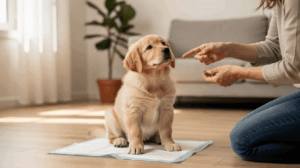
Which to choose: If outdoor elimination is your long-term goal and you have safe, reliable access, beginning with a consistent outdoor potty area can avoid a later transition. If outdoor access is limited, an indoor potty station can be a practical temporary or permanent option.
When transitioning, move the potty pad gradually toward the exit and then outside. There is no guaranteed timeline for this transition, so adjust the process according to your puppy’s progress. Taking your puppy to the same area consistently encourages elimination, whether the designated spot is a pad or an outdoor potty area.
Puppies that have not completed their initial vaccine series should not automatically be kept indoors for all potty training. Ask your veterinarian which private or low-risk outdoor areas are appropriate in your community, and avoid dog parks or heavily used dog areas where exposure may be higher. The American Veterinary Medical Association recommends using caution around places where dogs gather until the initial vaccination series is complete.
Common Challenges and Professional Solutions
Even well-planned training can encounter setbacks. Accidents are a normal part of potty training. What matters is how you respond and adjust the routine.
Frequent Accidents Despite a Consistent Schedule
If your puppy eliminates indoors despite regular trips, the schedule may not be frequent enough for that puppy’s current needs. Increase the frequency of breaks and reduce unsupervised freedom. If you catch your puppy beginning to eliminate indoors, calmly interrupt without frightening them and carry or lead them to the correct potty area to finish.
Handle accidents calmly without punishment or yelling. Punishment can create fear and confusion, potentially causing a puppy to hide when it needs to eliminate rather than signal you. Clean the area thoroughly with an enzymatic cleaner. Some standard household cleaners may leave scent traces that a puppy can detect, increasing the likelihood of returning to the same area.
If accidents persist despite a consistent routine, consult your veterinarian to rule out urinary tract problems, digestive issues, parasites, or other medical causes. Seek veterinary guidance sooner if your puppy shows pain, straining, diarrhea, increased thirst, blood in the urine, or unusually frequent urination.
Regression After Initial Success
A puppy that seemed house trained may begin having accidents after a move, travel, a new household member, a disrupted schedule, stress, or reduced supervision. However, a sudden or persistent change can also be associated with urinary, digestive, or other medical problems.
Temporarily return to the previous age-appropriate schedule as though your puppy were younger. Increase supervision, reintroduce appropriate confinement during unsupervised periods, and reinforce the potty cue and correct location. Identify possible stress triggers, maintain a consistent routine, and avoid changing several parts of the puppy’s schedule at once.
Contact your veterinarian when regression is unexplained, frequent, or accompanied by physical or behavioral changes.
Puppy Won’t Signal or Communicate Needs
Some puppies do not develop clear signals on their own and need explicit teaching. Introduce bell training by hanging bells at nose height near the door used for potty trips. Before each trip, gently prompt your puppy to touch the bells, then go directly to the designated potty area and reward successful elimination.
If your puppy has not started signaling consistently, continue using pre-emptive scheduled breaks while practicing the signal. There is no fixed deadline for learning this behavior, and some puppies need substantially more repetition before the association becomes reliable. Scheduled trips should remain the foundation of the routine until your puppy’s signal is dependable.
Next Steps and Professional Support
Age-appropriate routines can prevent many common potty training problems. When you match your expectations and schedule to your puppy’s developmental stage, you work with your puppy’s current abilities instead of expecting too much too soon.
Your immediate action steps:
- Assess your puppy’s current stage based on age, current accident frequency, and individual behavior.
- Implement the corresponding schedule from this guide and establish consistent feeding, sleeping, and potty-break routines.
- Track progress weekly by recording accidents, successful potty trips, and overnight needs.
- Adjust incrementally by extending intervals in small steps after consistent success. If accidents return, shorten the interval and increase supervision.
When to consider professional or veterinary help:
- Persistent accidents despite consistent supervision, frequent breaks, and an age-appropriate routine
- A sudden increase in accidents or physical signs such as straining, pain, diarrhea, increased thirst, or unusually frequent urination
- Regression associated with anxiety, fear, marking, or another behavior concern
- Difficulty creating or maintaining an effective routine, in which case a structured puppy board-and-train program or private dog training lessons may provide professional guidance
Professional training can support the process, but continued scheduling, supervision, and reinforcement at home remain necessary.
Related training to explore: Potty training lays the foundation for broader obedience. Once your puppy’s potty habits are becoming reliable, building on that foundation with basic obedience training can strengthen attention, communication, and everyday manners.
Potty trips also provide opportunities for early leash training with your puppy. Calm, supervised trips to the designated potty area can help your puppy become more comfortable wearing a leash without turning every bathroom break into a long training session.
Frequently Asked Questions
How often should I take my puppy outside to potty?
Very young puppies may need potty opportunities every 30 to 60 minutes during active periods and every 1 to 2 hours during quieter waking periods. By 3 to 4 months, some puppies can wait 2 to 3 hours, but they should still go out after meals, drinks, naps, play sessions, and crate time.
What is the best way to handle accidents indoors?
Handle accidents calmly without punishment. Clean the area thoroughly with an enzymatic cleaner to remove odors that might attract your puppy back to the same spot. If you catch your puppy beginning to eliminate, calmly guide them to the designated potty area without scolding or frightening them.
How can I spot when my puppy needs to go potty?
Watch for signs such as sniffing, circling, restlessness, pausing an activity, moving toward the door, or suddenly squatting. Not every puppy gives an obvious warning, so scheduled potty trips should continue even when your puppy appears to be developing a signal.
Does early neutering affect potty training?
Neutering may reduce sexually motivated urine marking in some male dogs, but marking is different from incomplete potty training and may also be associated with anxiety, social conflict, or an established habit. Neutering does not teach appropriate potty behavior or directly improve bladder control. Discuss the appropriate timing with your veterinarian because recommendations vary by breed, size, sex, health, and individual risk factors.
How long does potty training usually take?
Many puppies become reliably potty trained by around 6 months of age, but some need longer. Progress depends on the puppy’s development, health, previous experience, daily schedule, supervision, and training consistency.
Can I potty train my puppy indoors using pads?
Indoor potty training with pads can be effective, especially in high-rise apartments or when immediate outdoor access is unavailable. If outdoor elimination is the long-term goal, gradually move the pad toward the door and then to the intended outdoor location. The transition timeline varies by puppy, so continue rewarding each successful elimination in the correct place.
