


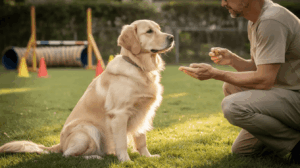
There is no universal answer to how long it takes to train a dog. A dog may begin learning a simple cue within a few sessions, while reliable obedience around distractions can require much more practice. Behavior concerns and specialized skills may take longer still. Your dog’s age, health, temperament, training history, environment, goals, and the consistency of practice all influence the timeline.
This article covers realistic expectations for different stages of the training process, from foundational obedience and potty training through behavior modification, off-leash reliability, and more advanced skills. Whether you’re raising a young dog from puppyhood or working with an adult dog on established habits, understanding the difference between learning a skill and maintaining it can help you set practical expectations.
Understanding how long dog training can take helps you choose an appropriate training approach and recognize the difference between completing a program and maintaining a skill over time. Training progress is rarely determined by program length alone.
Here’s what you’ll learn:
- How different stages of dog training affect the time needed
- Key factors that can influence training progress
- How professional programs differ from owner-led training
- Common challenges that can slow progress
- Why ongoing reinforcement matters after initial training
Understanding Dog Training Fundamentals
Before discussing timelines, it helps to define what “trained” means for your individual goals. A dog that reliably sits in the living room may still need additional practice to respond around other dogs, unfamiliar people, traffic, wildlife, or other distractions.
Teaching a dog is a gradual process. First, the dog learns what a cue means. Then, the behavior is practiced in different environments and under increasingly difficult conditions.
Basic Obedience vs. Comprehensive Training
Basic obedience may include cues such as sit, down, place, recall, and leash manners. A dog can begin understanding some of these skills quickly, but reliable responses require continued practice in different situations.
More advanced training focuses on maintaining learned behaviors around increasing distractions, distance, and duration. Behavior concerns such as aggression, significant reactivity, or separation-related distress should be assessed separately from routine obedience because they may require specialized behavior or veterinary support.
There is no fixed amount of time in which every dog becomes reliable in real-world settings.
The Learning vs. Proofing Distinction
The learning phase is when a dog begins to understand what a cue means. A dog may learn the basic idea of “sit” quickly, but that does not mean the behavior will be equally reliable in every environment.
Proofing means practicing a learned behavior with different distractions, distances, durations, and locations. Dogs do not automatically apply a skill learned in one setting equally well to every other setting, so repeated practice is important.
Understanding the difference between initial learning and proofing helps explain why completing a training lesson or program is not the same as having permanent reliability. Professional programs can provide concentrated practice and structured exposure, but continued owner practice remains important.
Training Timeline by Skill Level
The sections below explain how training demands usually change as skills become more difficult. These are training stages rather than fixed timelines, and dogs may progress through them at very different rates.
Basic Commands and Foundation Skills
Foundation training introduces skills such as sit, down, recall, place, and leash manners in manageable environments. Young puppies can begin learning simple cues as soon as they come home, while adult dogs can also learn new foundation skills at any age.
Keep training sessions short enough that your dog remains engaged. Several brief practice opportunities are often more productive than a single long session. How quickly a dog understands a cue varies, and learning the basic behavior is only the first step toward reliable obedience around distractions.
Intermediate Obedience and Increasing Distractions
Intermediate training involves practicing familiar skills around greater distractions and introducing behaviors such as leave it, drop it, improved leash manners, and stronger impulse control.
Progress depends on the dog’s previous training and ability to remain engaged in increasingly challenging environments.
Adolescence can also affect consistency. Many dogs become more independent or distractible during this stage, although the timing and intensity vary by individual and breed. If a previously reliable behavior becomes less consistent, reduce the difficulty temporarily and reinforce the foundation before progressing again.
Advanced Training and Behavior Goals
Advanced training may include stronger recall, distance work, off-leash obedience where safe and legally permitted, and reliability around increasingly difficult distractions. The time required depends on the starting skill level and the reliability expected.
Behavior modification does not have a standard completion timeline. Aggression, significant reactivity, fear, and anxiety vary greatly in cause and severity, and some cases require ongoing management or veterinary involvement in addition to training.
Board & Train can provide concentrated daily obedience practice over a defined program period, but program duration should not be confused with permanent mastery. The current standard Southern Delaware Board & Train programs focus on obedience and are not designed for aggression or major behavioral issues.
Factors That Impact Training Duration
No two dogs follow the same training timeline. Several factors can affect how quickly a skill develops and how much practice is required for reliability.
Age and Development Stage
Age can influence the way training is structured, but it does not provide a reliable prediction of how quickly an individual dog will learn.
Puppies: Young puppies can begin foundation training early, with emphasis on safe socialization, household routines, handling, and simple cues. Sessions should remain manageable for the puppy’s attention level. House-training progress varies considerably and should not be assigned a universal completion deadline.
Adolescent dogs: Adolescence can bring greater independence, energy, and distraction. Previously learned skills may become less consistent in difficult environments, so owners may need to reinforce foundation behaviors and adjust expectations temporarily.
Adult dogs: Adult dogs can learn new cues and change existing habits. Previous training, reinforcement history, health, environment, and behavior concerns all affect the pace of progress.
Senior dogs: Older dogs can continue learning. Training should account for mobility, sensory changes, cognitive health, and other age-related needs rather than assuming that age alone makes learning slow.
Breed and Individual Temperament
Breed can influence traits such as activity level, persistence, social behavior, motivation, and responses to particular tasks, but breed alone does not determine how quickly a dog can be trained. There is no simple ranking of universally “fast” and “slow” learners.
Individual temperament, reward preferences, previous experience, health, stress level, and training history often matter just as much in everyday training. Choosing rewards and exercises that motivate the individual dog can make training clearer and more engaging.
Training Method and Consistency
Training methods, reinforcement, practice frequency, and clarity all influence the learning process. Reward-based training uses things the dog values to increase desired behavior and is supported by current veterinary behavior guidance.
Consistency is also important, but more training time does not automatically mean faster learning. Short, focused practice that the dog can successfully engage with is often more useful than long or inconsistent sessions.
| Training Format | Structure | Timeline Consideration |
| Owner-led training | Practice incorporated into daily life | Progress depends on goals, skill, consistency, and environment |
| Private lessons | Trainer coaches the owner and dog across scheduled sessions | Program length reflects lesson structure, not guaranteed mastery |
| Board & Train | Concentrated training while the dog stays with a trainer | Program duration is fixed, but owner follow-through is still needed |
| Behavior-focused training | Individualized work based on the behavior concern | Timeline can vary considerably and may involve ongoing management |
Current Southern Delaware private obedience options are structured as four- or eight-lesson programs, while standard Board & Train options last one or two weeks. Those are published program lengths, not universal promises for how long it takes a dog to become permanently trained.
Professional Training Options
At-home training can work well when owners have the time and knowledge to practice consistently. Professional guidance may be useful when you need help progressing a skill, want hands-on coaching, have specific obedience goals, or are dealing with more challenging behavior.
Families considering dog training in Dover and Southern Delaware can compare professional formats based on their dog’s age, behavior, previous training, and goals.
The current dog training services include private lessons, Board & Train, puppy training, obedience training, therapy-dog preparation, and specialized behavior-focused options.
Before selecting a program, review the current plans and pricing because program structure, eligibility, equipment, and availability may change.
Standard Board & Train is intended for obedience rather than aggression or major behavioral issues. Dogs with aggression, significant reactivity, fear, or other serious behavior concerns may need a specialized assessment and training plan.
Common Training Challenges and Solutions
Even with a good training plan, certain habits can make progress less consistent.
Inconsistent Practice Schedule
Problem: Irregular practice can make it harder to build and maintain reliable responses, particularly when a behavior is still new.
Solution: Incorporate brief training opportunities into everyday routines. Ask for appropriate behaviors before meals, during walks, at doorways, or during play. Short, regular practice is generally more useful than relying on occasional long sessions, and there is no universal daily minute requirement.
Mixed Messages From Family Members
Problem: Different cues and conflicting household rules can make expectations less clear. For example, allowing jumping in one situation while discouraging it in another can make reliable behavior harder to establish.
Solution: Agree on consistent cues and household expectations whenever possible. Family members should understand which behaviors are being reinforced and how to respond so the dog receives clearer feedback.
Rushing Through Foundation Skills
Problem: Increasing difficulty too quickly can make successful responses less likely. A dog that understands a behavior indoors may not yet be ready to perform the same behavior around strong distractions.
Solution: Increase difficulty gradually. Build reliability in manageable environments before adding greater distance, duration, or distraction. If progress stalls, reduce the difficulty and rebuild successful repetitions before moving forward.
Lack of Real-World Proofing
Problem: A dog that responds reliably at home may still struggle in unfamiliar or distracting environments because dogs need practice applying learned behaviors in different contexts.
Solution: Gradually increase distraction levels and practice in appropriate locations where dogs are permitted. Introduce more challenging environments incrementally and reduce the difficulty if your dog is unable to remain engaged.
Conclusion and Next Steps
There is no single answer to “how long does it take to train a dog?” Simple skills can begin developing quickly, while reliable obedience around distractions, advanced training, and behavior modification may require substantially more practice. A professional program may have a defined start and end date, but maintaining trained behaviors depends on continued reinforcement and consistent practice after the program ends. Focus on identifying the specific behaviors you want to improve, practicing in short and manageable sessions, and gradually reinforcing those skills in different environments. Professional training may be appropriate depending on your dog’s age, behavior, previous training, and goals, while aggression, significant reactivity, or other serious behavior concerns may require a more specialized assessment rather than a standard Board & Train program. If you are considering professional help, contact us today to discuss your dog’s current skills, behavior, and training goals and learn which available training option may be appropriate.
Frequently Asked Questions
How long does it take to train a puppy?
There is no universal puppy-training timeline. Young puppies can begin learning simple cues and household routines early, but house training, socialization, leash skills, and reliable obedience develop at different rates. Continued practice is necessary as the puppy grows and encounters new environments.
What are positive reinforcement techniques in dog training?
Positive reinforcement means adding something the dog values after a desired behavior so that behavior becomes more likely to occur again. Rewards can include food, toys, praise, or play. Veterinary behavior guidance recommends reward-based training methods.
How long does behavior modification take?
There is no standard timeline for behavior modification. Progress depends on the behavior, its underlying causes, severity, history, environment, management, and the individual dog. Aggression, significant fear, anxiety, or sudden behavior changes may also require veterinary or specialized behavior support.
Can working dogs such as police dogs be trained faster?
Not necessarily. Police, detection, service, therapy, and other working roles involve different tasks and qualification standards, so their training timelines cannot be directly compared. Selection, temperament, training history, task complexity, and performance requirements all influence the time needed.
How important is consistency in dog training?
Consistency helps dogs understand which behaviors are being reinforced. Household members should use clear cues and compatible expectations whenever possible, while recognizing that training difficulty should increase gradually.
Is dog training a long-term commitment?
Yes. Completing an initial training program does not eliminate the need for future practice. Reinforcing learned behaviors and practicing them in different situations helps maintain reliability as the dog’s environment and experiences change.
